
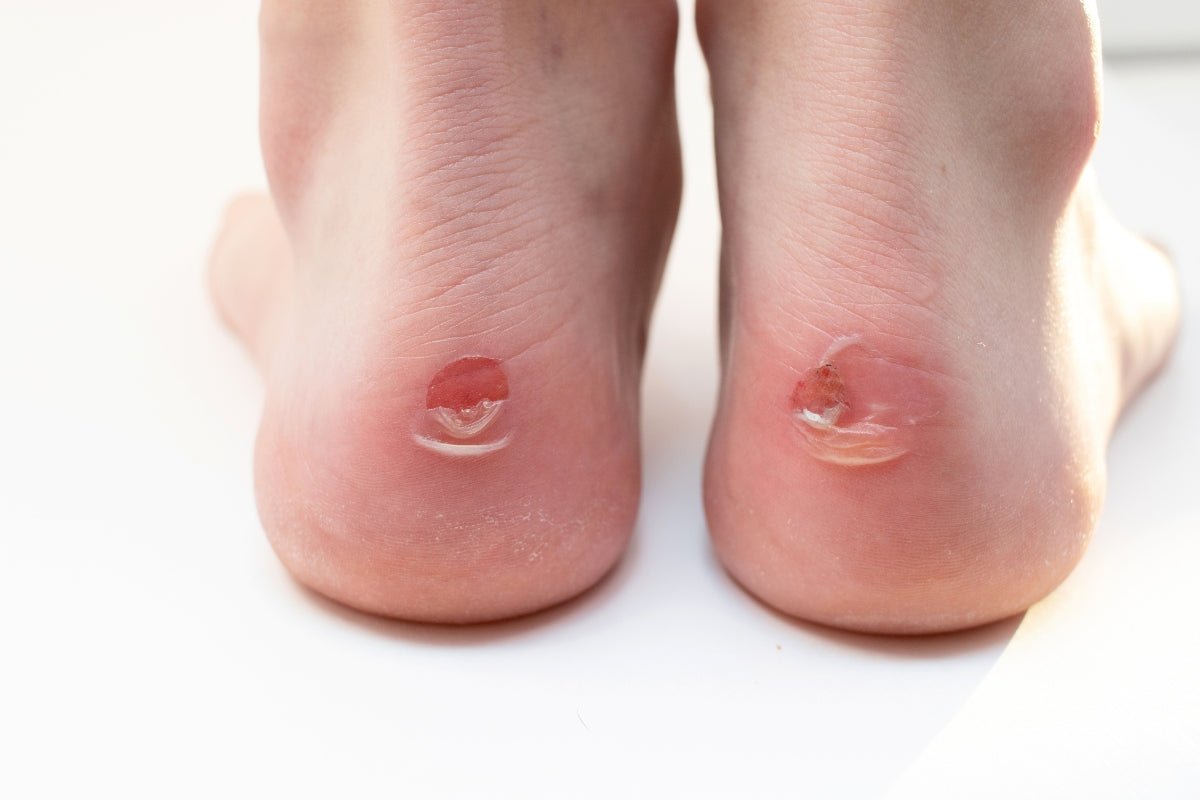
Foot blisters are one of the biggest enemies of athletes and walkers. Seemingly harmless, these small, fluid-filled blisters can become a real ordeal, significantly reducing athletic performance and even forcing the person to stop exercising.
A blister can turn a long run or hike into a painful experience, limit performance, and even lead to more serious injuries if not treated properly.
In this article, we explain what blisters are, why they appear, how to treat them safely, and what to do to prevent them.
What exactly are blisters?
A blister is a small pocket of fluid that forms between the layers of skin in response to repeated friction or burns. In the case of the feet, this fluid—usually serum—accumulates as a defense mechanism to protect the lower layers while the skin regenerates.
The combination of sweat, pressure, and friction is the ideal breeding ground for blisters, especially if repeated for hours without interruption.
Friction blisters occur when a specific area of the foot experiences constant friction, usually during prolonged activities such as running, walking, or hiking.
The heat generated by this friction, along with the moisture from sweat, weakens the epidermis and causes its layers to separate.
Why do blisters form on the feet?
The main cause of foot blisters is repeated friction on the same area of skin. There are multiple factors that increase the risk of blisters during physical activity. The most common are:
- Improper socks , especially cotton socks or those that slip or wrinkle inside shoes.
- Shoes or boots that fit poorly , are too tight or have too much room.
- Excessive moisture inside the footwear, either due to sweat or external conditions.
-
Repeated friction on pressure points such as the heel, arch of the foot, or toes.
Skin not adapted to the load, as in the first days of training or during the first stages of the Camino de Santiago .
The combination of sweat, pressure, and friction is the ideal breeding ground for blisters, especially if repeated for hours without interruption.
Most common areas for blisters to appear
Blisters don't appear randomly; they usually form in specific areas of the foot that bear the most pressure or are most exposed to friction:
- Heel : Especially at the back and side.
- Fingers : Both at the tips and on the sides, particularly between adjacent fingers.
- Sole of the foot : Mainly under the metatarsal heads (the "pad" of the foot).
- Plantar arch : Less common, but can occur especially in flat feet or those with structural abnormalities.

How to prevent blisters from appearing
Prevention is always the best strategy when it comes to blisters. By implementing some simple but effective measures, we can significantly reduce the risk:
Wear appropriate footwear
Make sure the shoe fits your foot properly. If it's too tight or too loose, your foot will move and cause friction. There should be about a centimeter of space between your longest toe and the tip of the shoe.
Another basic tip is to gradually adapt to the physical activity you're about to do. Never break in new shoes for long or intense activities. Use them first for short sessions so they adapt to your foot.
It's also important to invest in socks without internal seams, as the seams end up causing friction when in contact with the skin.
But the main advice when it comes to footwear is to use a shoe specific to the activity you're doing. Just as you wouldn't wear a wool sweater to swim in a pool in the summer, don't use shoes that aren't specifically designed for your activity, whether it's running, trail running, hiking, etc.
Technical socks: the most effective barrier
Socks are much more than just a barrier between your foot and your shoe; they're a fundamental preventive tool. If you're going to play sports, wear technical socks, not cotton ones. Socks made of synthetic fibers help wick away sweat, keeping your feet cool and dry. Cotton, on the other hand, retains sweat and promotes the development of blisters.
It's also important to invest in socks without internal seams, as seams can cause chafing when they touch the skin. Even a small crease in the sock can create a constant area of chafing. Seamless socks or socks with an anatomical design, like Podoks, minimize this risk.
Podoks biomechanical socks prevent blisters thanks to:
- CoolMax® fabric: A technical material that wicks away perspiration and keeps feet dry, significantly reducing the risk of blisters caused by moisture.
- Open Stitch System: Eliminates traditionally problematic seams that can cause chafing.
- Ergonomic design: It adapts perfectly to the anatomy of the foot, avoiding folds and wrinkles that generate friction points.
- Hallux toe separation: A unique design that improves stability and reduces friction between the toes.
- Strategic compression bands: Prevent the sock from shifting inside the shoe during physical activity.
-
Padding in critical areas: The heel and metatarsal area have additional reinforcement that absorbs impacts and reduces friction.
Skin preparation
It's essential to pay attention to humidity, as this, along with heat, is the main risk factor for blisters. Some athletes use special talcum powder to keep their feet dry.
You can also find moisturizing creams on the market to help keep your feet properly hydrated, although we recommend not applying them just before physical activity, as they increase the risk of moisture buildup.
And if you haven't exercised for a long time, it's essential to gradually expose your feet to activity. For athletes who train regularly, the skin can gradually harden, becoming more resistant to friction. But if you haven't gone for a walk in the last six months, don't rush off on a 15-kilometer hike, as your skin won't be accustomed to that level of intensity.
Specific protection techniques
Use petroleum jelly or anti-friction creams on areas of your feet where you perceive a risk of blisters. This is especially useful during long runs or stage races, whether on foot or by bike.
Preventative bandages, strategically placed before the blister appears in areas that often experience friction, can also be helpful. In specific cases, you can consult your podiatrist for a functional bandage, although the ideal is to choose a suitable sock designed to minimize friction.

How to treat a blister safely
Despite our preventive efforts, blisters sometimes appear. In these cases, proper treatment is essential to minimize pain and speed recovery.
The course of action for a blister will depend on its size, location, and condition. Here are the basic guidelines recommended by dermatology and sports medicine specialists.
If the blister has not burst
- Do not puncture it unless absolutely necessary.
- Clean the area with water and neutral soap.
- Apply a protective dressing such as Compeed or a hydrocolloid bandage to prevent friction and speed healing.
- Avoid continuing the activity if you notice pain or increasing tension in the affected area.
If the blister is large, very painful, or seriously interferes with normal activity, it may need to be drained. In this case, consult a podiatrist.
If the blister has burst
- Wash the area carefully and do not remove the raised skin, as it acts as a natural barrier.
- Apply a mild antiseptic (such as chlorhexidine).
- Cover the area with sterile gauze or a special blister dressing.
- Change the bandage daily and monitor for signs of infection (pus, redness, or excessive heat).
Important: In certain cases, blisters require medical attention: if they appear without apparent cause, if they recur in the same location, if they become infected, or if the person has conditions such as diabetes or circulatory problems.
Conclusion: Blisters are not inevitable
Foot blisters, although seemingly trivial, can have a significant impact on our quality of life, especially if we exercise regularly. The good news is that with the right prevention strategies, we can drastically reduce their incidence.
Avoiding blisters isn't a matter of luck. It's a matter of knowledge, preparation, and proper equipment. If you run or walk frequently, taking care of your feet should be a central part of your routine.
And in that care, choosing the right socks is just as important as choosing your footwear. Podoks offer active protection, designed to prevent chafing, friction, and overload. Because preventing a blister is always better than treating it.
Frequently asked questions about foot blisters
Is it good to prick blisters?
It's not recommended to puncture them if they haven't burst on their own and aren't intensely painful. Puncturing them incorrectly can open the door to infection. Only if the pain is very painful or the area is under a weight-bearing area (such as the heel) is it reasonable to do so, always using sterile equipment and disinfecting it afterwards.
Is it better to cover them or leave them exposed?
It depends on the condition. If you're going to continue walking or running, it's best to cover them with special bandages to prevent them from opening. If you're resting and in a clean environment, you can let them air out for a few hours to promote healing.
What can I do to prevent them if I've had them before?
In addition to wearing technical socks like Podoks, you can apply petroleum jelly to areas of friction, reinforce with preventative dressings (such as Compeed® on the heel), and make sure your shoes fit properly.
Are anti-friction or antiperspirant powders useful?
They can be useful in certain conditions of extreme heat or high humidity. But they're no substitute for good socks and footwear. In fact, some poorly applied antiperspirants can dry out the skin and make it more prone to breakouts.
How long does it take for a blister to heal?
Healing time varies depending on several factors. Small, injectable blisters take an average of 3 to 7 days. Large or broken blisters take an average of 4 to 14 days to heal. Infected blisters may require weeks and specific medical treatment.
-----
Scientific references:
Martínez-Nova, A., Marcos-Tejedor, F., Gómez-Martín, B., & Sánchez-Rodríguez, R. (2022). Reduction of dynamic plantar pressures in the medial plantar forefoot with biomechanical socks . Spanish Journal of Podiatry, 33(1), 19-26.
Martínez-Nova, A., Jiménez-Cano, L., & Gómez-Martín, B. (2023). Treatment for plantar fasciitis with biomechanical socks: preliminary results of a randomized clinical trial . Revista Española de Podología, 34(2), 87-94.
Martínez-Nova, A., & Monzó-Pérez, F. (2024). Biomechanical Effect on Jack's Test on Barefoot Position , Regular Socks and Biomechanics Socks. Research Gate.
Knapik, JJ, Reynolds, KL, Duplantis, KL, & Jones, BH (1995). Friction blisters. Pathophysiology, prevention and treatment . Sports Medicine, 20(3), 136-147.
Bogerd, CP, Niedermann, R., Brühwiler, PA, & Rossi, RM (2012). The effect of two sock fabrics on perception and physiological parameters associated with blister incidence: a field study . Annals of Occupational Hygiene, 56(4), 481-488.
Lipman, GS, Ellis, MA, Lewis, EJ, Waite, BL, Lissoway, J., Chan, GK, & Krabak, BJ (2014). A prospective randomized blister prevention trial assessing paper tape in endurance distances . Wilderness & Environmental Medicine, 25(4), 457-461.
Hashmi, F., Richards, B.S., Forghany, S., Hatton, A.L., & Nester, C.J. (2017). The formation of friction blisters on the foot: the development of a laboratory-based blister creation model . Skin Research and Technology, 23(3), 429-438.




1 comment
Mari jose Rodríguez
Yo probare los calcetines, pero no lo sé,a mi todos los veranos me salen ampollas con el calor,y no hago caminatas de kilómetros, me quito las zapatillas y tengo los pies ardiendo, tenía que haber algo qué me los enfriara.. Un saludo
Leave a comment
All comments are moderated before being published.
This site is protected by hCaptcha and the hCaptcha Privacy Policy and Terms of Service apply.